
Week 5
Watch the movie “The Greatest Movie Ever Sold” (The official title is “POM wonderful Presents: The Greatest Movie Ever Sold”) and answer the questions that follow.
1-Do you think the movie provides insight or detail into what drives product placement in entertainment?
If so, what have you learnt from that? If not, how would you change aspects of the movie to reflect insight on this?
The movie shows how the entertainment industry benefits from displaying products in films and tv shows as they get a substantial amount of money from the company. This money, in some cases, is essential to fund the movie, as is the case for “The Greatest Movie Ever Sold”. It was also interesting to see the strict contracts they have to sign and how much power the companies get over the content or promotion of the film. Of course, the bigger the movie or show, the bigger the audience they reach, and the higher the businesses are willing to pay. This also happens in sports and other sectors. Even some schools feel forced to use product placement in their school buses to get enough funds.
2-What have you observed about presentations of visual strategies/brand identity?
It is essential for the brands that the movie shows a positive image of their identity that won’t hurt their reputation. Thus, they want to have as much control as possible over how it is done and use all their power to do so.
3-Let’s consider this movie as a form of research. In other words, it was done to see what the effect of branded entertainment would be, a case study of sorts. What are your findings? What have you learnt? What has changed your pre-conceived ideas? Do you think there’s relevance in this case study? How could you apply your observations in real life?
I knew there was product placement in the entertainment business and sports, but I did not realise how much and the impact it has on our decisions. It is scary to see how we are being influenced at all times and the tricks and techniques used. It’s especially alarming when the target is children or teenagers, as they are much more vulnerable. I think it’s deceiving and commercials should be marked as such, so the audience knows when they are being targeted.
4-From the findings above (question 3) imagine that the international coffee brand, Starbucks, is your client. Give one complete strategy for a small activation campaign to advertise Starbucks on aeroplanes. Give one idea of how you would do this, by following the 5 steps of the work process. To guide you, follow the points below and do a write-up of your idea as well as the steps you followed:
Conduct research – you can visit the website http://www.starbucks.com as part of your research. Also think of quick research methods, such as surveys done on family and friends.
For my research, I first visited http://www.starbucks.com and read the sections About us and Careers. The company claims to offer great coffee while helping make the world a little bit better.
On their menu, one can find high-quality coffee, hot and iced beverages, teas, Frappuccino blended beverages, as well as pastry, sandwiches, yoghurt, salads and snacks.
Starbucks offers a full and rewarding coffeehouse experience and aims to be a neighbourhood gathering place where people come to chat, meet up or even work.
It’s their goal for all their coffee to be grown under the highest standards of quality, using ethical sourcing practices.
I also researched in-flight advertising and found out there are many possibilities: advertising in airline’s magazines, on electronic displays, sampling in planes, seatback inserts, on boarding passes, lunch boxes, on folding tables, on the headrests, overhead bins…
On their homepage, Starbucks is promoting their Rewards program, where customers earn stars every time they make a purchase and then can redeem them for free drinks or food. I decided to create the campaign for this program: passengers will find instructions on how to sign up for the Rewards plan on their folding tables. When they scan the QR code to download the app and create the account, they get a free Spring special onboard – one of their seasonal beverages-. I chose this approach because the passengers will be sitting in front of the advertisement for a long time, and, nowadays, many airlines offer free wi-fi to their customers. They will have the time to go through registering for the Starbucks Rewards and enjoy a treat for free while getting to their destination.
Clarify the strategy – Once you’ve conducted quick research, do a write-up of your findings and create your own brief.
After the research, I created the following brief:
The company: Starbucks is an American multinational that is the largest coffeehouse chain in the world, with more than 32.000 stores in 83 markets. Its headquarters are in Seattle, Washington.
Brand’s mission: To inspire and nurture the human spirit – one person, one cup and one neighbourhood at a time.
Brand’s vision: Offer high-quality products while creating a community, helping create a positive impact on the communities they serve.
Target audience: High to middle-income coffee lovers aged 25 to 50. They are busy office workers who enjoy a cup of coffee on their way to work.
Key stakeholders: Partners, customers, suppliers, investors and neighbours.
Main competitors: Costa Coffee, McDonald’s McCafe, Dunkin’ Donuts.
Campaign: The campaign aims to promote the Starbucks Rewards program, which allows the customers to earn stars with every purchase that they can redeem for free drinks and food. The Rewards plan helps build customer loyalty. The advertisement is going to be placed on the folding tables of aeroplanes, where it will be visible during most of the journey. The ad will show a QR code that the passengers can scan to download the Starbucks app and sign up for the program. Once they do, they get a complimentary Spring special beverage onboard.
Design the identity – Here you do not need to go into lengthy design, but create sketches of your ideas and remember to think about the movie for inspiration.
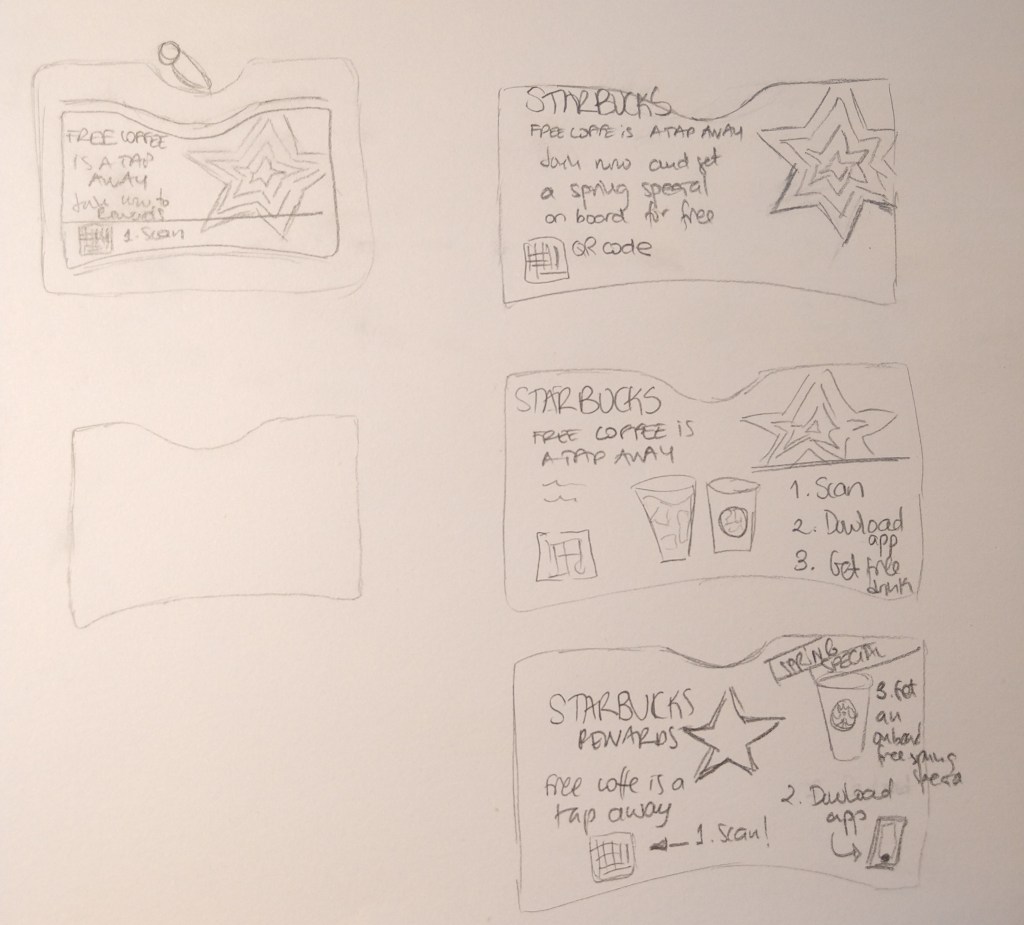
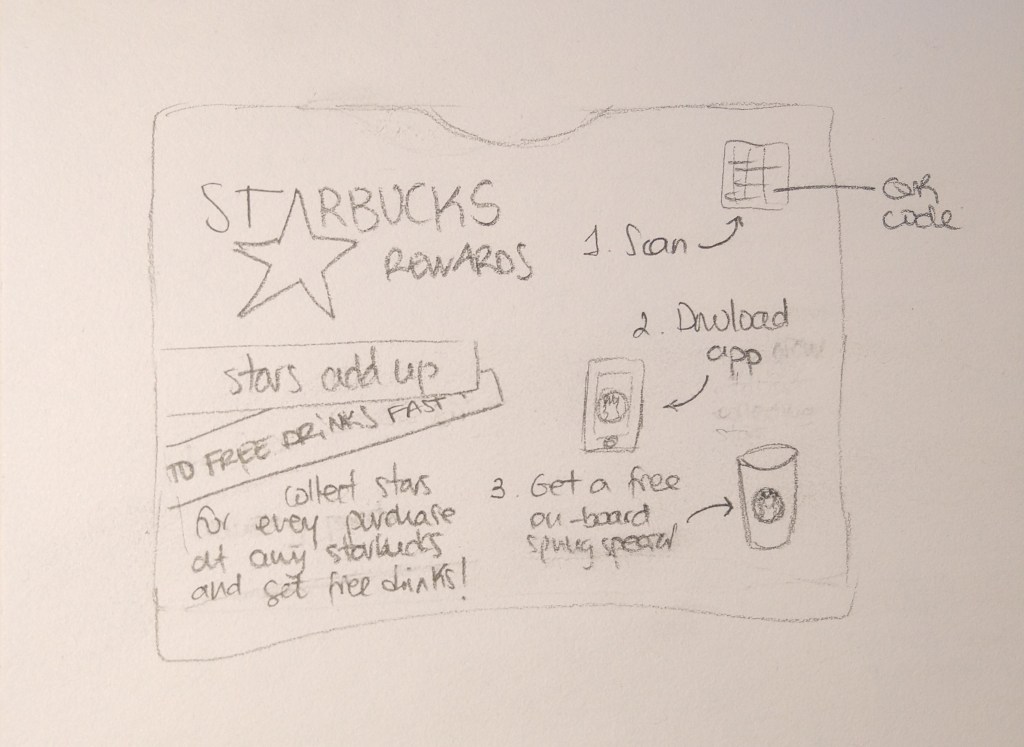
Create touchpoints – As this is a focused campaign, you may have one touchpoint only; describe how you would activate your campaign using this touchpoint. If you need to, you may do sketches that would aid your communication.
The first touchpoint would be the Starbucks app that the customer downloads on the plane. Then, the free beverage they get onboard after signing up for Starbucks Rewards.
Manage the assets – As this is not a prolonged campaign, briefly describe how you would use the possible outcome of your campaign for future use. Also state what your follow-up steps would be to strengthen your message. For example, you’ve done research and decided to give free vouchers along with every boarding pass handed out. How would you collect feedback from consumers or how would you communicate to them at the airport, on the flight, etc. to support your campaign?
Thanks to the unique QR code on the plane ads, we can collect data about how many passengers signed up for the Rewards program during the weeks the campaign was active. Once a client is registered, Starbucks can send notifications to their phones with information about discounts, campaigns or new products. If the campaign works well, it can be done periodically, offering different drinks or snacks as complimentary during the flight.
Sources:
https://theairport.org/inflight-advertising.html
https://www.avia-adv.ru/en/placement/in-flight
https://smallbusiness.chron.com/target-market-coffee-71600.html
https://www.madsjunction.com/marketing/starbucks-competitors
https://bit.ly/3xA8oLA
 Mónica's Design Journey