Acquainting yourself with the work process

Week 5

Consider the different steps in the work process and answer the following questions in writing:

Conduct research
Write down different means of conducting research (what do you think can be done to collect information and get consumers’ perspective on a proposed idea?)

The type of research will depend on the product and the budget. It is vital to understand the organization: its mission, vision, target markets, corporate culture, competitive advantage, strengths and weaknesses, marketing strategies, and challenges for the future.

The first step would be to ask the client for any relevant document or information about the business. Then, interview key people, preferrably face-to-face to get insight into the voice, cadence, and personality of the organization.

To understand the brand from a customer’s perspective, it’s important to study the target market and their experience with the brand. We can do this with one-on-one customer interviews, online surveys, trained mystery shoppers or usability and product testing.

When working with an existing brand, identifying what has worked and what has been successful or even dysfunctional provides valuable learning in the creation of a new identity. For that, we need to first gather all materials that show the history of the organization like marks, logotypes, colour, imagery, typography, look and feel.

Last but not least, we should examine the competition, their key messages and their identity in the marketplace. Besides gathering information on the internet, it’s a good idea to experience the competition: navigate their websites, visit shops and offices, purchase and use their products/services, etc.

Clarify the strategy
What do you think should be included in a creative brief (as a designer, what would you consider vital information in such a brief?)

Once we have gathered enough information from the reaseach stage, the next step is to interpret this data. All of the learnings from the research and audits are distilled into a unifying idea and a positioning strategy. Agreement is solidified about target markets, competitive advantage, brand core values, brand attributes, and project goals. More often than not, the definitions of the problem and its challenges have evolved. It is important to put the findings along with the decisions made in writing, so we can refer back to it and use it to back our thoughts when communicating with clients.

The creative brief should include the brand’s description, project context and background, define the target market, explain the objectives and outline the deliverables, identify the competition, detail the tone, message and style, specify the budget and list the key stakeholders.

Design the identity
How would you approach the findings from the research and the clarified strategy (what would your first steps be once you’ve received feedback and a brief?)

After reserach and brief are in place, we can move on to visualisation and start developing the brand identity in its visual form. I would begin by finding inspiration and creating a moodboard. I’d start brainstorming and sketching ideas on paper. It’s important to test different colours, typefaces, layout and patterns during the design process. It’s also important to test the viability of concepts and make a presentation to show the client how the product would look like and how it would be perceive by the end customer.

Create touchpoints
What do you think is meant by touchpoints (what, do you think, should be included in the term “touchpoints”? how would you define this term?) Hint: Keep in mind that touchpoints are those things that connect customers to your brand.

Touchpoints are those areas and moments that the consumer comes in contact with the service or product or company itself. Examples of touchpoints are: business cards, letterhead, brochure, website, favicon, signage, packaging, poster, advertisment, interaction with an employee, etc.

Manage the assets
How would you nurture and grow the brand that you’ve created (you may choose an existing brand or product and describe this according to your chosen item, if that will make it easier for you to explain your ideas)?

To keep the brand alive, we could: conduct an internal launch, communicate with employees about the new brand identity, create standards and guidelines to ensure that all future applications adhere to the intention of the program, launch the new brand identity externally to key stakeholders, create accountability, identify those people who champion the brand and develop a checks-and-balances method to audit progress.


Sources:

Designing Brand Identity, A. Wheeler.

Upwork, “10 Key Elements of a Successful Creative Brief”: https://www.upwork.com/resources/how-to-create-successful-creative-brief
Building a Mobile-Friendly Website

Week 4

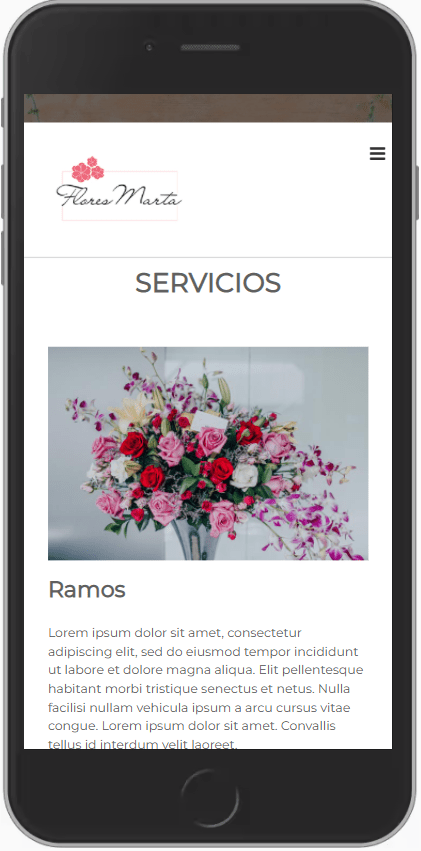
For this week’s assignment we had to build a mobile-friendly website from scratch using WordPress and customising a theme to fit the client’s needs. Since the web I created last week was already mobile-friendly, I was advised by my tutor to use the same for this assignment. Here is a link to last week’s post.

Below I have attached screenshots of the desktop and mobile version of the website.

Building a Website From Start to Finish

Week 3

  1. Write a detailed brief for your website
  2. Create a wireframe according to the brief
  3. Draw some sketches to plan your design
  4. Build a working website according to these specs

It’s important for me to see that you can follow through on the entire process – from the brief to the completed website.

Please explain why you make certain decisions. How do these decisions fit in with the business strategy?Upload your brief, wireframe, sketches and link to your website to your WordPress blog. There’s quite a lot to do for this assignment, so it’s advisable to keep your website simple.

I decided to continue with the same client as last week.

BRIEF

Flores Marta is a small local florist’s located in Valladolid, Spain. We offer flower arrangements for events, interior decoration, funeral flowers and gifts. We receive part of our flowers and plants directly from Holland, one of the world’s biggest producers. Besides, we have our own nursery in the town’s outskirts, where we grow the rest of our products. This way, we guarantee the freshness of our plants and flowers, so they last longer.

Business Strategy

Mission Statement
Normalise flowers and plants’ use in day-to-day life by offering fresh, durable and affordable arrangements and solutions.

Objectives
1 – Sell flowers and plants
2 – Offer a wide variety of floral arrangements
3 – Grow a trust relationship with the community

Value Proposition
1 – Fresh and long-lasting products
2 – Personalised arrangements
3 – Support local commerce and community

Elevator Pitch
Flores Marta guarantees fresher, longer-lasting cut flowers in your home or event.

How the website would fit into your business strategy
I want my website to showcase the work we do, showing photos of the bouquets and arrangements we prepare. Initially, we will not sell online because we prefer to create a relationship with the clients first and offer them personalised assistance. We want to use the web as a catalogue for our customers, where they can also find the contact details and address for them to contact or visit us. In the future, when the community has grown, we would like to introduce online shopping. The web should clearly state the origin of our products and our involvement in the local community. I want the website to reflect our brand with a fresh, clean design. It must be easy to navigate.

Web Architecture

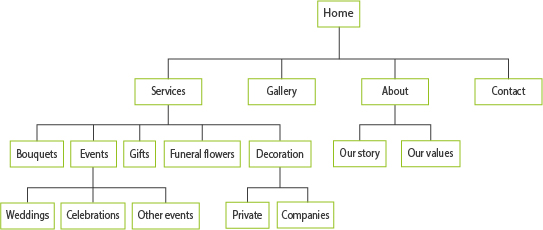
The website is a one-page with anchor points to the different sections.

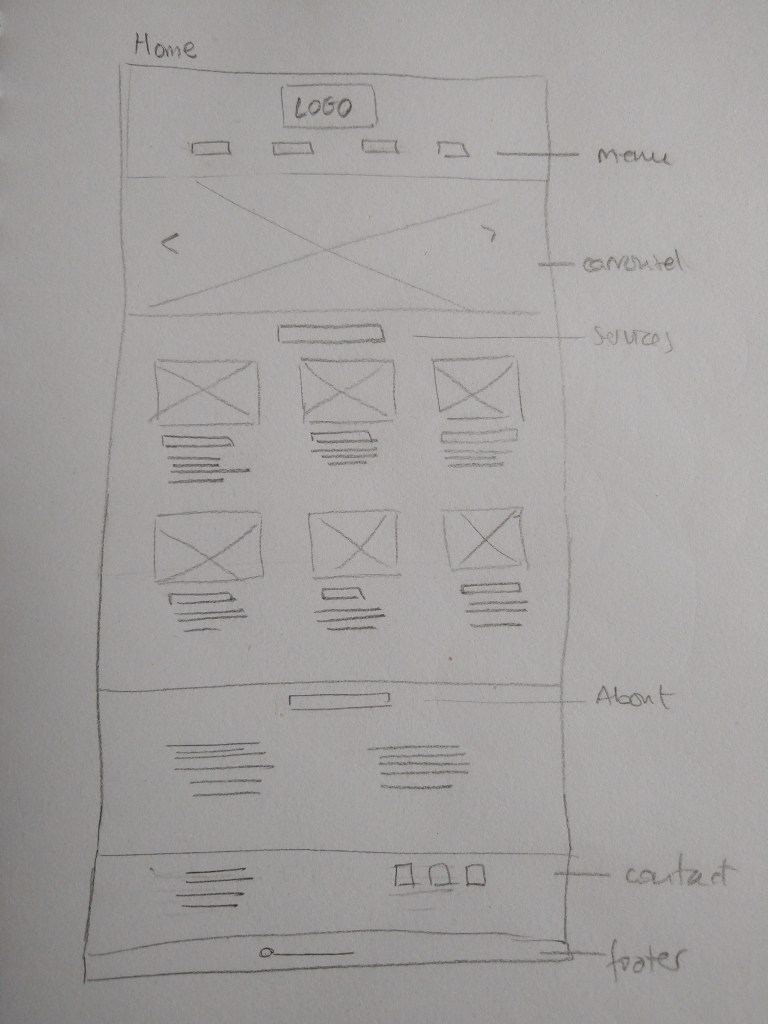
WIREFRAME

I chose to use a low-tech wireframe because it is a small website, the client has a limited budget and it allows me to make changes easily.

WEB STRATEGY

Domain and hosting
The domain name suggested to my client is the business’ name, which is relevant, memorable and usable. For the suffix, we chose .com since it is available. We also decided to purchase .es, the specific suffix in Spain, and redirect it to http://www.floresmarta.com. For hosting, I recommended BlueHost, as it is currently ranked as one of the best services for small businesses, ideal for WooCommerce and very popular for WordPress sites.

Since this is a fictitious client, I didn’t purchase the domain mentioned above or host with BlueHost. Instead, I created a subdomain in the domain I have for this course with one.com.

Design
The website design will be clean and fresh, intuitive and user-friendly with a focus on visual content. It will display correctly in all browsers and be responsive on mobile. A picture carousel in the website header will show the florists’ most relevant work. The web will only be updated occasionally on special dates. The business’ Instagram feed will be displayed on the site to show pictures of the latest orders and work.

The design is clean and balanced; I chose to have a white background and use cover pictures to separate the different sections. I was planning to have a carousel in the header but could not figure out how to do it in the limited time I had for this Lesson Task, so I decided to use a single picture instead and continue with the design. The gallery section is missing from the web; my idea was to link the client’s Instagram feed to display on the web. Because it’s not a real client, I have no Instagram account to display, but if I had, I would have installed the plugin Instagram Feed to show the feed. I used placeholder text except for the headings, menu and details. The web is in Spanish as the fictitious flower shop is located in Spain.

Target Audience
My client wants to target local women between 25 and 55 who enjoy shopping in their town and support local businesses.

I used soft, feminine colours to appeal to the target audience. The pictures in the about section (Quienes somos) show women taking care of the plants and flowers sold at the florist. In a real situation, the text would have reinforced the client’s values of support to the community and local businesses/flower producers.

Programming
The web will be built in WordPress, as it is easier for my client to manage the occasional updates they might need. Some features can be customised with additional CSS and modifying the PHP files. Once they are ready to add online orders, it will be easy to add WooCommerce to the web to create the shop.

I used the WordPress theme Flash to build the website and customise it mainly using its options and adding plugins. All the pictures are optimised for the web, improving web performance. 

Much more could be done to make a better web, but I decided to keep it simple since this is a Lesson Task and I had limited time. I have learned a lot while building the web, and I realise how much more I still have to know if I want to become better at developing webs with WordPress.

Designing for performance

Week 3

This Lesson Task was about performance and I was to find 5 examples of websites coded and designed for performance.

Web performance refers to the speed in which web pages are downloaded and displayed on the user’s web browser. Faster website download speeds have been shown to increase visitor retention and loyalty and user satisfaction, especially for users with slow internet connections and those on mobile devices. Web performance also leads to less data travelling across the web, which in turn lowers a website’s power consumption and environmental impact. (Wikipedia, 2021)

These are the 5 examples I have found:

Coming Up With a Strategy

Week 2

For this week’s assignment I had to find a business owner and ask them what they want from a website, what their business strategy is and how the website would fit into it. After writing a detailed document about it, I should create the website architecture. Last, I was to create the website design strategy and justify all the major decisions I make on domain registration and hosting, design, target audience and programming.

ABOUT THE BUSINESS

Name
Flores Marta (fictitious client)

Product or service
Flores Marta is a small local florist’s located in Valladolid, Spain. We offer flower arrangements for events, interior decoration, funeral flowers and gifts. We receive part of our flowers and plants directly from Holland, one of the world’s biggest producers. Besides, we have our own nursery in the town’s outskirts, where we grow the rest of our products. This way, we guarantee the freshness of our plants and flowers, so they last longer.

BUSINESS STRATEGY

Business’ Name 
Flores Marta

Mission Statement
Normalise flowers and plants’ use in day-to-day life by offering fresh, durable and affordable arrangements and solutions.

Objectives
1 – Sell flowers and plants
2 – Offer a wide variety of floral arrangements
3 – Grow a trust relationship with the community

Value Proposition
1 – Fresh and long-lasting products
2 – Personalised arrangements
3 – Support local commerce and community

Elevator Pitch
Flores Marta guarantees fresher, longer-lasting cut flowers in your home or event.

How the website would fit into your business strategy
I want my website to showcase the work we do, showing photos of the bouquets and arrangements we prepare. Initially, we will not sell online because we prefer to create a relationship with the clients first and offer them personalised assistance. We want to use the web as a catalogue for our customers, where they can also find the contact details and address for them to contact or visit us. In the future, when the community has grown, we would like to introduce online shopping. The web should clearly state the origin of our products and our involvement in the local community. I want the website to reflect our brand with a fresh, clean design. It must be easy to navigate. 

WEBSITE ARCHITECTURE

WEBDESIGN STRATEGY

Domain and hosting
The domain name suggested to my client is the business’ name, which is relevant, memorable and usable. For the suffix, we chose .com since it is available. We also decided to purchase .es, the specific suffix in Spain, and redirect it to http://www.floresmarta.com. For hosting, I recommended BlueHost, as it is currently ranked as one of the best services for small businesses, ideal for WooCommerce and very popular for WordPress sites.

Design
The website design will be clean and fresh, intuitive and user-friendly with a focus on visual content. It will display correctly in all browsers and be responsive on mobile. A picture carousel in the website header will show the florists’ most relevant work. The web will only be updated occasionally on special dates. The business’ Instagram feed will be displayed on the site to show pictures of the latest orders and work.

Target Audience
My client wants to target local women between 25 and 55 who enjoy shopping in their town and support local businesses.

Programming
The web will be built in WordPress, as it is easier for my client to manage the occasional updates they might need. Some features can be customised with additional CSS and modifying the PHP files. Once they are ready to add online orders, it will be easy to add WooCommerce to the web to create the shop.

Creating a Brief

Week 1

This is the first Lesson Task (previously called Learning Activity) of the second year of Graphic Design (GRA2).

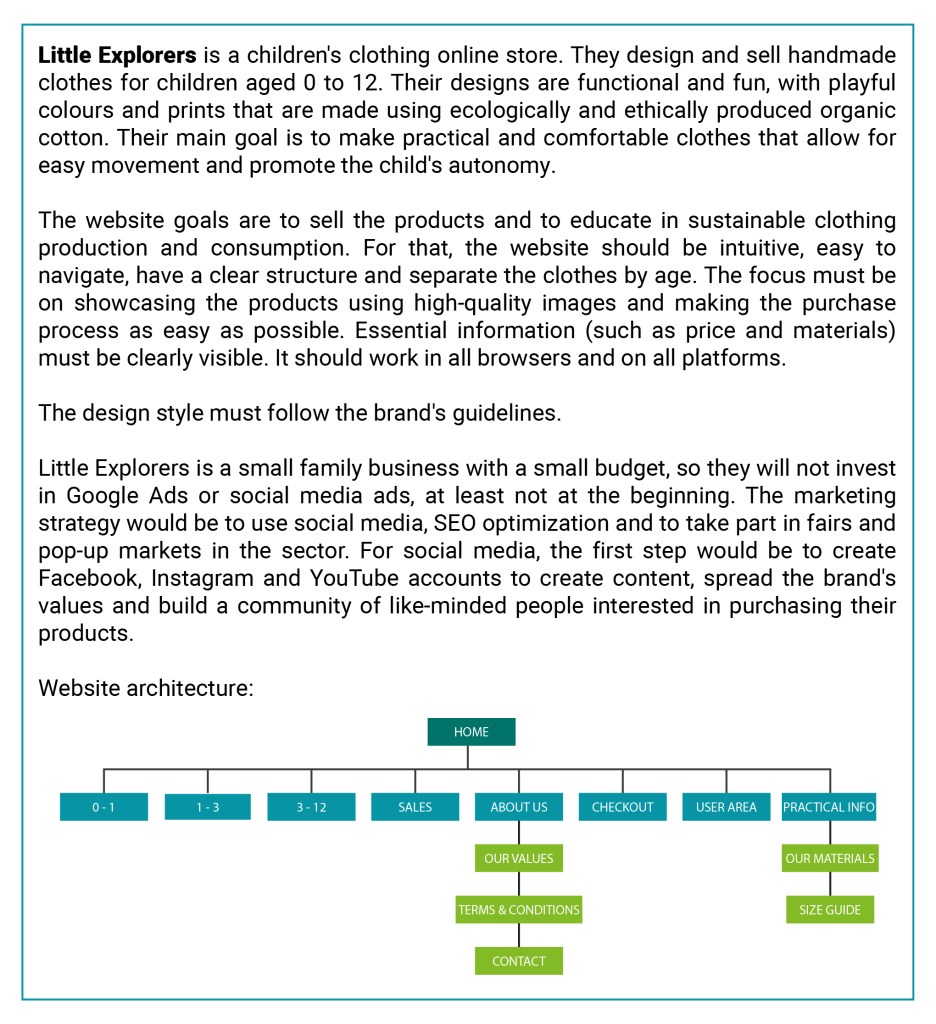
In this case, I was to create a detail brief for a client’s website. This brief should contain all the information that will be needed to achieve the client’s requirements. It should be good enough to hand over to any design/programming team and get a great result.

The brief should cover the following sections:

  • What is the client’s service/product?
  • What are their requirements?
  • What is the website’s goal?
  • How are you going to achieve this goal?
  • Build the website architecture (so we can see what sections will be needed)
  • What is the design style that will be required?
  • What are your suggestions for marketing the site?

I chose the same client as for my Semester Project last year. See the link here.